F-Gas 2027: how the heat pump market is shifting towards R290

As of January 1, 2027, the F-Gas regulation marks a turning point for the swimming pool heat pump market. Beyond a regulatory change, the entire sector is entering a new phase, with direct impacts on the technologies used, the product ranges available, and the strategic choices to be made.

Key takeaways

  • F-Gas 2027 restricts the use of high-GWP refrigerants in swimming pool heat pumps
  • The sub-50 kW market is directly impacted
  • R290 is gradually becoming the new standard
  • Not all manufacturers have reached the same level of maturity
  • Decisions made today will shape the years ahead

F-Gas 2027: a defining shift for the swimming pool heat pump market

The F-Gas III regulation aims to significantly reduce the use of fluorinated greenhouse gases (HFCs, hydrofluorocarbons), with a target of -95% emissions by 2050.

It follows a progressive timeline with several key milestones:

  • January 1, 2027: ban on the import and manufacture of heat pumps < 50 kW using refrigerants with a GWP ≥ 150
  • January 1, 2030: phase-out of heat pumps > 50 kW using HFCs
  • 2050: target for HFC neutrality

For the swimming pool heat pump market, the shift begins as early as 2027, leading to a lasting transformation of product standards.

A shift that goes beyond regulation

These developments are not purely regulatory.

They directly impact:

  • technology choices
  • available product ranges
  • market strategies
  • customer support

The market is not just evolving regulations — it is redefining its standards.

R290: a transition already underway

In response to these developments, R290 is gradually becoming the reference for swimming pool heat pumps.

This refrigerant offers several key advantages:

  • very low environmental impact
  • natural availability
  • compatibility with technical requirements
  • alignment with current industrial developments


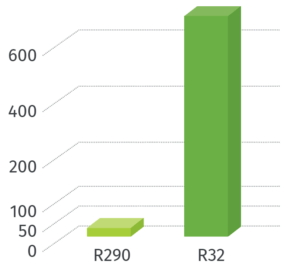
This gap explains the ongoing transition in the market.

Refrigerant GWP*
R290 3
R32 675

*GWP: Global Warming Potential

Beyond the refrigerant: evolving technologies

The transition to R290 is not limited to a simple change of refrigerant.

It requires a broader evolution of heat pump design:

  • higher operating pressures
  • component adaptations
  • updated control logic
  • wider operating conditions

A well-designed R290 heat pump can achieve high levels of performance.

However, these developments also have an impact on manufacturing costs.

A market still adapting

While the transition to R290 is widely announced, the reality of the market is more nuanced.

We observe:

  • varying levels of readiness
  • industrial infrastructures still adapting
  • performance claims sometimes optimized in communication
  • products still under development

True mastery of the technology is becoming a key differentiating factor.

R290: POLYTROPIC’s experience

If the transition to R290 is underway, not all market players currently have the same level of expertise.

At POLYTROPIC, this shift has been part of a long-term approach.

The first R290 heat pumps were introduced as early as 2018, with the GREEN290, CARE290 and ELITE290 ranges.

Today, this represents more than 6 years of experience with this refrigerant.

This experience ensures:

Anticipating what’s next

The transition to R290 is now underway and is part of a broader evolution of the swimming pool heat pump market.

It involves:

  • anticipating product range developments
  • securing supply chains
  • supporting customers
  • maintaining consistent performance levels

The choice of refrigerant is becoming a strategic factor for the years ahead.

Glossary – understanding R290 challenges

  • HP (Heat Pump): a system that captures heat from the air to warm water.
  • GWP (Global Warming Potential): an indicator of a gas’s impact on global warming. The lower the value, the lower the environmental impact.
  • HFC (Hydrofluorocarbons): greenhouse gases used in many heating and air conditioning systems, targeted by F-Gas regulations.
  • R290: a natural refrigerant (propane) with very low environmental impact, used in next-generation heat pumps.
  • R32: a commonly used refrigerant in heat pumps, but with a higher environmental impact than R290.

FAQ – F-Gas 2027 and pool heat pump

Units already on the market may continue to be sold on a transitional basis, but their manufacture and import will be discontinued from 2027 onwards.

It is not a direct requirement. However, regulatory constraints linked to F-Gas 2027 are gradually making high-GWP alternatives less viable for swimming pool heat pumps.

The market is therefore clearly moving towards very low-GWP refrigerants, such as R290.

R290 offers a very low GWP (3) along with strong thermodynamic performance, making it a suitable solution for the market’s evolving requirements.

Yes, the transition is already underway across the market. However, not all players have reached the same level of maturity in developing and integrating this technology.

At POLYTROPIC, we already have several years of hands-on experience with R290, with solutions proven in real-world conditions.

Heat pumps

ELITE R290 range

The eco-responsible heat pump

MASTER-INVERTER range

The intelligent swimming pool heat pump

MORPHEO range

Customisable heat pumps

OTTIMO range

Unique design and high technology

URBAN range

Special for small pools

RAK Inverter range

Special for local authorities

INDOOR range

The invisible CAP!

STEPIO range

SPA Special

MINI STEPIO range

Special for small SPAs

SPA INVERTER range

SPA Special

CRYO INVERTER range

Special cryotherapy

Other equipment

You are looking for

a product, a piece of advice, a technical data sheet?

MENU

ELITE R290 range

MASTER-INVERTER range

MORPHEO range

OTTIMO range

RAK Inverter range

INDOOR range

MASTER-INVERTER range

RAK Inverter range

MORPHEO range

URBAN range

STEPIO range

MINI STEPIO range

SPA INVERTER range

CRYO INVERTER range